Bernarda Conceals the Truth About Adela’s Death
The House of Bernarda AlbaBernarda’s concealment of the truth about Adela’s death is the play’s final act of rule: confronted with the death of her youngest daughter, she orders the household to present Adela as a virgin and suppresses any account that might damage the family’s standing. The commands do not undo the death; they determine what the family is permitted to say about it. In that difference between what has happened and what Bernarda declares, the household’s public honour takes precedence over grief and truth.
The Household’s Established Code
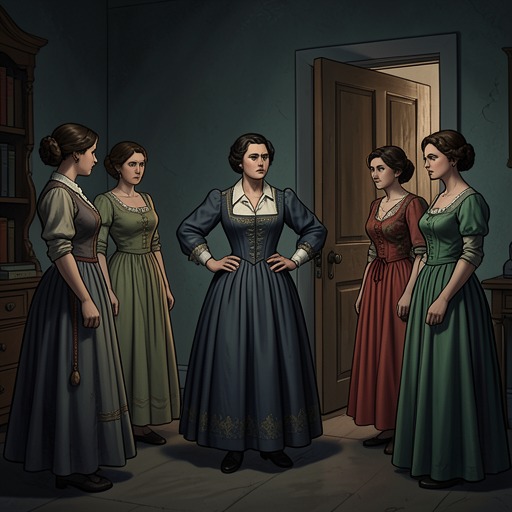
Bernarda’s response grows out of rules she has imposed throughout the play. At the opening funeral, she cuts off the Servant’s mourning with a command to be silent, then rebukes her for failing to make the house sufficiently clean for the mourners and sends her away. Bernarda’s authority thus governs not only her daughters but also the household’s expression of grief and the appearance it presents to visitors.
She also states a gendered division of life as a household rule: women are to sew, while men have the whip and mule. Her commands make domestic confinement and obedience seem like the proper order of things, rather than choices open to her daughters. Near the end, when the family’s conflict has become impossible to contain, she again claims the power to impose order, invoking the five chains she has for her daughters and the house her father built. The final concealment extends this established authority from regulating the living to controlling the account of the dead.
From the Village’s Violence to the Death in the House
The play has already shown how sexual reputation can expose a woman to communal punishment. Poncia tells the household that Librada’s unmarried daughter killed her child and hid it beneath stones; after dogs brought the body to her doorstep, men from the village pursued her. Bernarda welcomes the crowd’s demand to kill the woman, while Adela protests that she must not be killed. The episode places Bernarda’s defence of social honour in direct contrast with Adela’s resistance to violence against a woman condemned by that code.
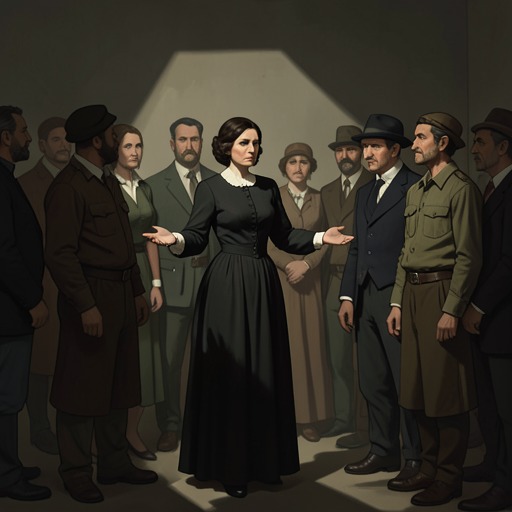
At the end, the struggle over reputation moves from the village into Bernarda’s own house. After Poncia enters and recoils, the sisters draw back and the Servant crosses herself. Bernarda refuses to enter, then turns to Pepe, declaring that he has escaped this time but will fall another day. Her attention shifts immediately to managing the aftermath: she orders Adela’s body cut down, carried to her room, and dressed as a virgin. The command links the family’s private tragedy to the sexual honour by which the village judges women.
The Cover-Up and Its Language
Bernarda’s declaration is not a neutral description of what has occurred. She insists that Adela died a virgin, repeats the claim, and orders that nobody say anything. She also instructs the household to announce that the bells should ring twice at daybreak. Clothing, public announcement, and silence all become parts of a single effort to make the family’s preferred version prevail beyond the house.
Her language turns authority into action. Earlier, her command to the Servant to be silent had enforced discipline in the presence of mourners; at the close, the repeated demand for silence is directed at the daughters and accompanied by an explicit prohibition on weeping. Bernarda allows tears only in private. Even mourning must therefore be managed as a matter of appearance: grief may exist, but it must not become a public statement that competes with the family’s official account.
Honour, Gender, and the Ending
The play’s commentary connects Bernarda’s concern with reputation to a society in which women’s sexual conduct could become public gossip and tarnish a family name. The commentary also notes the historical force of honour violence: Spain’s Penal Code of 1870 allowed a husband to cleanse his honour with blood in specified circumstances, and that provision was not repealed until 1963. The drama does not present Bernarda’s orders as an application of that legal provision; rather, her response belongs to a broader culture in which a woman’s sexual reputation could invite social condemnation and violence.
The ending exposes the contradiction at the heart of Bernarda’s rule. She has spent the play insisting on command, domestic obedience, and control of what the neighbours might hear. At the close, she again treats silence as a means of protecting family honour, but the need to repeat her claim reveals how urgently that honour is threatened. Her final insistence that the household drown itself in mourning while maintaining that Adela died a virgin binds public performance and private loss together: the family is ordered to mourn, yet forbidden to speak plainly about the death that has made mourning necessary. The play ends on Bernarda’s renewed command for silence, leaving her version of events as the household’s imposed public truth.